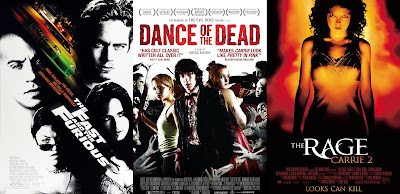
Video Scripts: The Fast and the Furious, Dance of the Dead, The Rage: Carrie 2
Cody shares a few more videos he wrote for JoBlo and Arrow in the Head.
I have been writing news articles and film reviews for ArrowintheHead.com for several years, and for the last couple years I have also been writing scripts for videos that are released through the site's YouTube channel JoBlo Horror Originals. Recently I started writing video scripts for the JoBlo Originals YouTube channel as well. I have previously shared the videos I wrote that covered
Three more videos that I have written the scripts for can be seen below, one for the JoBlo Originals channel and two for JoBlo Horror Originals.
For the non-horror Revisited series, I wrote about director Rob Cohen's 2001 franchise starter The Fast and the Furious:
The Fast and the Furious script:
INTRO: One of the biggest action franchises of the last twenty-five years had humble beginnings. It started with a simple little movie about street racing, based on a magazine article, with a cast of young people who weren’t very well-known and action scenes that are relatively grounded. That movie has somehow spawned multiple sequels and a spin-off. Along the way, those further installments have gotten bigger, crazier, and more over-the-top, while earning over six billion dollars at the worldwide box office. The movie we’re talking about is the 2001 release The Fast and the Furious – and it’s time for it to be Revisited.
SET-UP: The Fast and the Furious wouldn’t have happened if it weren’t for journalist Kenneth Li. That’s who wrote the article called Racer X for the May 1998 issue of Vibe magazine. Li’s two thousand word write-up looked into the urban street racing phenomenon that had made its way to New York after starting in Southern California. The racers Li met were catching the attention of police by shutting down the Henry Hudson Parkway near Manhattan to hold their illegal races. After run-ins with the law, some of them would take their races to legal racetracks, and they were looking forward to competing in Drag Wars, the Tri-State area’s first import street drag competition. This Vibe article caught the attention of executives at Universal Pictures. When they got in contact with Li about buying the film rights to the article, he thought it was a prank. But the offer was real: Racer X was going to become a movie.
Universal passed the article over to producer Neal H. Moritz, who was in the middle of working on The Skulls. A college-set thriller directed by Rob Cohen, starring Joshua Jackson and Paul Walker. The idea was that Moritz would produce this Racer X movie with Cohen directing. Moritz instantly saw the appeal of the concept, since he liked stories about subcultures. But Cohen didn’t see how the article could serve as the foundation for a movie. There wasn’t a story there, it was just about young people fixing up their cars and racing them. But then he went to a real illegal street race in California… and he started to understand how a movie could work. There would be racing, but inside an action-packed crime movie plot. Something along the lines of Point Break, but with cars instead of surfboards. Moritz and Cohen were already working with an actor who would be ideal for such a project: Paul Walker, who wanted to play an undercover cop in something, and to make a movie about racing cars. So even before a script had been written for the Racer X project, Walker signed on to star as the undercover cop who infiltrates a group of illegal street racers.
Now it was up to the screenwriters to get the story on the page in a satisfying way. The idea was to mix elements from Point Break and Donnie Brasco, which was about an FBI agent going undercover in the mafia. As well as thematic values from The Godfather: namely, a focus on family. As this franchise continued, the amount of times the word “family” is spoken in the films would become something of a running gag. Writers Gary Scott Thompson and Erik Bergquist were able to provide the basic set-up for what would become The Fast and the Furious. Then David Ayer was hired to do a rewrite, and he got the story closer to what we see in the finished film. That’s because Thompson and Bergquist’s drafts were still set in New York, like the magazine article. Ayer said he would only sign on if he could set it in Los Angeles, the original home of these street races, and make the characters more diverse. And that’s exactly what he did.
The project went through several different titles during development and production. Racer X, Race Wars, Street Wars. For a while, it was called Redline. The problem was, all of these titles seemed cheesy. Then Moritz watched a documentary on legendary producer Roger Corman. One of Corman’s early projects was a car chase film called The Fast and the Furious, released in 1954. And when that title came up in the documentary, Moritz realized it would be the perfect title for the movie he was making. So he pitched it to Universal and the studio was able to license the title from Corman. In exchange, Corman was able to use some stock footage that was owned by Universal.
The story Thompson, Bergquist, and Ayer crafted for this The Fast and the Furious centers on LAPD officer Brian O’Conner. The LAPD is working with the FBI to bring down a group of hijackers who have been pulling off highway robberies of trucks hauling loads of DVD players and digital cameras. There have been four robberies in the last two months, with over six million dollars worth of products stolen. The hijackers drive Honda Civics with Mashimoto ZX tires and green neon lighting. It’s clear that they’re from the street racing world. So Brian is to infiltrate that world, going undercover as a convicted car thief who now works at the auto shop where the racers get their parts. After a shaky start, Brian is able to befriend a group of racers headed up by Dominic Toretto. He’s able to earn Dom’s respect, and Dom can relate to his cover story because he has done some prison time as well. His father was a stock car driver who was killed in a race, and Dom attacked the driver responsible for the crash with a wrench. He went to jail for two years for nearly beating the guy to death. During his first night hanging out with Dom, Brian also meets a prime suspect in the hijacking case: Johnny Tran, a gang leader who is quick to send bullets flying if he feels someone has wronged him. Brian raids Tran’s home with the authorities… but his gang aren’t the hijackers. And then Brian realizes Dom is the leader of the hijackers, and the criminals are his new friends. Right at the start of Race Wars, a big drag race competition being held out in the desert, everything falls apart.
Universal told Cohen and Moritz that the movie would receive an instant greenlight for production if they cast Timothy Olyphant as Dom. But Olyphant had just been in a car movie the year before, Gone in 60 Seconds. He wasn’t interested in doing another one. The back-up choice Cohen and Moritz came up with was Vin Diesel, who was then best known for fighting aliens in Pitch Black and getting killed in Saving Private Ryan. When he said he wasn’t sold on the script, he was given the opportunity to sit down with David Ayer and go through it page by page. Together, they reworked Dominic Toretto, building him up and giving him a code of honor. Making him the type of guy who may be up to criminal business, but also regularly hosts a backyard barbecue for his friends that starts with someone saying grace. As Ayer told Entertainment Weekly, “I sat down with Vin and really created that character with him. Yeah, there were characters in the script but it needed life, it needed to become real, it needed to become dimensional. He had a few really specific ideas about the character, and those little touchstones he handed me became something I could flesh out. It’s an honor to help an actor create and achieve a vision.” And since Dom was said to own a Cuban bodega, Diesel went to Cuba to see what the real thing is like.
With Walker and Diesel locked in as Brian and Dom, the filmmakers built the supporting cast around them. Jordana Brewster, who didn’t have a driver’s license at the time, was cast as Dom’s sister Mia. Who becomes Brian’s love interest, much to the chagrin of Dom’s buddy Vince, played by Matt Schulze. Brewster had to get a license so she could drive in the movie, and so did Michelle Rodriguez, who was cast as Dom’s girlfriend Letty. In the script, Letty was just there to look good. The character had been described as a “trophy girlfriend”. Rodriguez demanded that she be given more depth and that her relationship with Dom be more layered. She also asked for a moment where she would get to punch somebody. Chad Lindberg was cast as the ill-fated Jesse, the computer and mechanics wizard of the group. And Johnny Strong was cast as Leon, the only surviving member of Dom’s team who hasn’t come back for any of the sequels. Strong has confessed that he hasn’t even watched the sequels.
Noel Gugliemi was cast as race organizer Hector. Ja Rule makes a cameo as a racer named Edwin. Ted Levine plays Sergeant Tanner, Brian’s supportive LAPD superior. Thom Barry is FBI Agent Bilkins, who’s in a hurry to catch the hijackers. And Rick Yune was cast as the villainous Johnny Tran.
Equipped with a budget of thirty-eight million dollars, The Fast and the Furious went into production in the summer of 2000. It was one of the least expensive movies Universal made that year. Maybe the cheapest of all. So the studio didn’t interfere with Cohen and Moritz while they were making the movie. And they made it on a tight schedule. Cohen said that nothing in the movie got the amount of time it should have had. They were always fighting the clock. But because the budget was low, they were allowed to do whatever they wanted. Even when they wanted to have neighborhood home owners repaint their houses in muted tones so the colorful race cars would look more vibrant on screen. And Universal was so pleased with the film they turned in, the decision was made to change the release date. The film was originally scheduled to reach theatres in March of 2001. They decided to push it back three months, making it one of their big summer releases.
REVIEW: The story of The Fast and the Furious works because they used the template of a movie that had already been successful ten years earlier. If you’re familiar with Point Break, watching this movie will have you feeling déjà vu at times. It covers a lot of the same ground. The undercover lawman infiltrating a group of fun-loving criminals. Romancing a woman who’s associated with that group. Not realizing his new pals are the people he’s looking for. Relating to the outlaws more than he relates to his fellow lawmen. Suspecting another group and conducting a fruitless raid on their base. Figuring out who he really needs to arrest just in time to find himself in the middle of a heist-gone-wrong. And, in the end, letting the mastermind walk away while other officers are closing in. The biggest difference here is that Keanu Reeves was letting Patrick Swayze surf off to his doom. Paul Walker lets Vin Diesel drive off to freedom… and a bunch of sequels.
So this was basically a Point Break remake long before we actually got a Point Break remake. But as the poor reception of the actual remake shows, just using a template isn’t everything. Many factors went into the success of The Fast and the Furious. The movie might not be accused of having a great script, but the script was exactly what it needed to be. The characters are fun and likeable, and each role was perfectly cast. That’s not to say that the acting is impeccable; some of the actors were just starting out and will admit that their performance wasn’t up to par. But there’s nothing too egregious on display. In some cases, as with Diesel and Rodriguez, the cast made the characters work better on film than they did on the page. And the actors had good chemistry with each other.
Walker and Diesel first bonded by attending a real, illegal street race together. When the race was broken up by the police, they ended up running down the side of the highway, hoping not to get caught. And so began a friendship that became more like a brotherhood. Walker reminded Diesel of his own twin brother, who also happens to be named Paul. They became a team that worked on several of these movies together. The pairing of Diesel and Rodriguez has also lasted throughout the franchise. Dom and Letty’s relationship was enhanced by the changes Rodriguez demanded, and it was expanded even further when Cohen saw how much chemistry the actors had with each other. Diesel has claimed that Dom and Letty have one of the greatest love stories in cinema history. And they’re not the only couple in this franchise that has an enduring love story. The connection Brian makes with Mia is a major part of the first film. Dom and Letty are already together when we meet them, but we see Brian and Mia falling for each other. We become invested in that relationship, which hits a major speed bump when Brian reveals he’s a cop. But that isn’t the end for Brian and Mia. They’ll be reunited a few sequels down the line.
This film also succeeded because it brought an interesting subculture to the screen. The young people who were already aware of these street races could see a version of themselves in the movie. And many of those who weren’t already aware of them were dazzled by the idea. The Fast and the Furious was nearly given a R rating due to injuries sustained by Vince in the disastrous final hijacking. Cohen made sure to cut back on the violence, as getting a PG-13 rating was very important. Teenagers had to be able to see this movie, especially those who weren’t old enough to get a license. Because, as the director said, who likes cars better than people who can’t drive them yet? There are plenty of cars to see. The Hondas, Toyotas, Nissans, Mitsubishis, Mazdas, Volkswagens, and Lexuses the racers drive. And the now iconic 1970 Dodge Charger that Dom keeps in his garage. His dad’s car.
The action sequences in the film are exciting even if you’re not into cars or the racing subculture. The hijackings and chase scenes are demonstrations of good, old fashioned stunt work. Cohen even drew inspiration from the 1939 John Wayne Western Stagecoach when plotting out the hijacking that opens the movie. These hijackings usually occur at night, with the criminals’ identities obscured by full-body dark clothing and helmets. The final robbery-gone-wrong takes place in broad daylight, and Dom and his crew are just wearing their regular clothes. This seems like a highly illogical decision on their part, but it was a choice that Cohen made for the benefit of the audience. The sequence happens during the day so the viewer can see everything that’s going on, and there’s no attempt to hide identities because we have to know what’s happening with each character.
For the race scenes, the director goes completely wild. These street races are only a quarter mile long and should be over in ten seconds. Which is why the characters are always talking about “ten second cars”. When Brian first competes in a race with Dom, the quarter mile race lasts for two minutes. The cars reach speeds as high as one hundred and fifty. The world outside their windows blurs like they’re hitting warp speed in a space ship and CGI takes us into the inner workings of the cars. It’s over-the-top and unrealistic, but it makes the race seem like something more than it would be if we just saw an actual ten second competition.
LEGACY / NOW: The Fast and the Furious was released on June 22nd, 2001 – and it connected with the audience the filmmakers had been hoping to reach. Point Break with cars turned out to be exactly what people wanted to watch that summer. The film opened at number one with forty million dollars and was on its way to earning over one hundred and forty-four million at the domestic box office. Internationally, it brought in almost sixty-two million more. Ending up with a total haul of more than two hundred and six million dollars. A great achievement for a movie that cost thirty-eight million.
Of course, Universal was instantly thinking sequel. And ironically, Diesel was against the idea, as he felt that a sequel would compromise the film’s chance of being considered a classic. So while the sequel gears started turning, he shifted his focus elsewhere. When The Fast and the Furious had started getting hype, Revolution Studios approached Diesel, Cohen, and Moritz with a project that would put a modern twist on the spy movie… by mixing in extreme sports. The month after The Fast and the Furious was released, it was announced that Diesel would be getting a ten million dollar payday to star in xXx, with Cohen directing and Moritz producing. But while Diesel and Cohen were busy getting up to spy business, Moritz still had time to produce the sequel to The Fast and the Furious that Diesel didn’t want.
Moritz has gone on to produce every film in the Fast and Furious franchise, guiding it from its scrappy street race movie origins to the globetrotting adventures these films became. Making billions for Universal in the process. One person who hasn’t seen a lot of money from the franchise is Kenneth Li, the journalist who wrote that Racer X article. Li was paid a six-figure lump sum for the film rights to his article. No percentage points, no residuals. And his friends make fun of him for making such a bad deal every time a new sequel is released.
Speaking with Entertainment Weekly, Diesel had this to say about not returning for the first sequel: “Sometimes you have to say no and stand for the integrity you hope to manifest in a film. Saying no in that moment of my life might have understandably been scary, and yet, it’s what allowed for everyone to commit wholeheartedly. Taking a pause is necessary when you want to really think about where you want to take something. (The franchise) totally started in a different place. It started very humble, and that’s something I’m grateful for, that we were able to start from humble beginnings so that you could really connect with these characters, without all the spectacle. The spectacle came as the movies needed to start one-upping themselves.”
But since Diesel skipped Part 2, the task of trying to one-up The Fast and the Furious fell on the shoulders of Paul Walker. He was the only cast member to return for the film that would come to be known as 2 Fast 2 Furious. And we’ll follow Walker’s character Brian O’Conner on his solo trip to Miami in the next episode of Revisited.
For the Best Horror Movie You Never Saw video series, I wrote about director Gregg Bishop's 2008 zombie horror comedy Dance of the Dead:
Dance of the Dead script:
Did you ever wonder what it would be like if the zombie apocalypse coincided with prom night? The dead rising from their graves, calling out for brains. Disrupting the school event that’s supposed to be a great, memorable moment in a teen’s life. That’s what happens in the 2008 film Dance of the Dead. Which would have been a great sequel to The Return of the Living Dead if it were part of that franchise. And if you haven’t seen it, it’s definitely The Best Horror Movie You Never Saw.
Although Dance of the Dead was released in 2008, the first draft of the screenplay was written eleven years earlier. Writer Joe Ballarini was attending the University of Southern California in 1997. Hanging out with a group of friends who regularly rented horror movies on VHS. One of the movies Ballarini watched with his friends was George A. Romero’s Dawn of the Dead… and while that is widely considered to be one of the best horror movies ever made, he was let down by the zombies. He wasn’t into the slow, lumbering flesh-eaters. He wanted to see fast zombies in a more explosive, funny movie. Something along the lines of Dan O’Bannon’s The Return of the Living Dead. Around the same time as his viewing of Dawn of the Dead, Ballarini was also reading the book Already Dead by Denis Johnson. Which includes the line, “And we listened faintly to the dance of the dead.” After reading that line, Ballarini was struck with the inspiration to write his own zombie movie. Dance of the Dead, about a zombie outbreak on prom night. A quickly-paced horror comedy with fast-moving zombies.
Ballarini showed the script to his classmate Gregg Bishop, who was so impressed by it that he said he wanted to direct the movie. Ballarini wanted to direct it himself, but he told Bishop that if he could find the money for it, he could do it. It took Bishop ten years, but he eventually did find the money and get the movie made.
Dance of the Dead is set in the small town of Cosa, Georgia, where a nuclear power plant stands right at the edge of the local cemetery. A leakage from this power plant is causing strange things to happen in the graveyard, but the caretaker is keeping it to himself. He just clips off the zombie body parts sticking out of the ground. Then drops the writhing appendages in his wheelbarrow. But he won’t be able to keep this secret for much longer. On the night the Cosa high school is having its prom, the living dead problem becomes a full-on zombie outbreak. A whole cemetery’s worth of dead people rise from their graves. These zombies don’t just come crawling out of the ground, though. These things burst through the ground like they’ve been launched from a catapult. Some catch several feet of air. Some hit the ground running. Running and crying out for “Brains!” That’s very reminiscent of The Return of the Living Dead – but luckily for the residents of Cosa, the zombies have the same weakness as in Romero’s movies. If you destroy the brain, you destroy the ghoul.
The characters we follow as the dead wreak havoc in Cosa include: Jared Kusnitz as irreverent pizza delivery boy Jimmy Dunn. Greyson Chadwick as Jimmy’s girlfriend Lindsey, who has decided to go to prom with someone else. And that date doesn’t go well at all. In fact, it goes bad even before the guy is torn to pieces. There’s Chandler Darby as the nerdy Steven. Who tried to ask cheerleader Gwen, played by Carissa Capobianco, to the prom. But she was hoping to go with Blair Redford’s character Nash Rambler. Lead singer of the band The Quarter Punks. His bandmates are Lucas Till as Jensen and Hunter Pierce as Dave the Drummer. None of them are going to the prom, since The Quarter Punks auditioned to play there and were rejected. The school isn’t into their type of music. It’s like the “You’re just too darn loud” moment in Back to the Future. But just like Marty McFly, The Quarter Punks do end up playing at the prom. That’s after they discover their music has a calming effect on the zombies. Ballarini was inspired to write scenes of zombies stopping in their tracks to listen to music after attending live music shows where he didn’t see anyone dancing. The audience would just stand there and stare at the band. Like zombies.
Also fighting for their lives against the living dead are Justin Welborn as redneck bully Kyle Grubbin. Mark Oliver as soldier-turned-phys-ed-teacher Coach Keel. James Jarrett as the sketchy gravedigger. And Randy McDowell, Michael V. Mammoliti, and Mark Lynch as Steven’s friends from the Sci-Fi Club.
Bishop held auditions for the cast in Los Angeles and Atlanta. Six hundred young actors were up for the roles of the Cosa high students. He wanted to find kids who were good at improv, who could bring their own personalities to their roles. And who actually looked like high schoolers. He didn’t want Dance of the Dead to be another teen movie where the actors are a decade older than their characters. He did a great job of assembling a strong cast that looks age-appropriate. The one exception he made was for Justin Welborn. He was indeed a decade older than his character, but he was still the best choice for Kyle. And he steals the show when he’s on the screen.
There was another character in the script who didn’t make it into the film. Her name was Lydia – and she was actually the lead. Originally, there was going to be a completely different explanation for the zombie outbreak. There was no nuclear power plant. The story began with a cheerleader named Lydia discovering that biology teacher Mister Hammond has murdered three of her friends. He has a copy of the Necronomicon is using the blood of students to call up the dead. Lydia escapes from the devil-worshipping teacher, then the police arrive and he gets shot to death. Jump ahead a year. Lydia has gone goth. And she crosses paths with the Necronomicon again just as the dead start to rise on prom night.
The role of Lydia was cast. But less than two weeks before filming was scheduled to begin, the actress decided to leave the project. Getting Dance of the Dead to the starting line had been a ten year journey, so Bishop and Ballarini couldn’t let it fall apart. They scrambled to figure out what to do about the Lydia situation. And quickly came to realize they didn’t really need that character. Even though she was the lead, she didn’t have much to do in the second act. She didn’t drive the story forward. So the decision was made to cut her out completely and shift the focus to Jimmy and Lindsey. As Bishop said, he didn’t feel connected to Lydia, but he did to Jimmy and Lindsey because “they’re the most real, the most interesting, and the characters we cared about.” Ballarini felt they deserved to become the main characters because “they are the ones who suffer the most. (The story is) about the two of them saving each other’s lives.” Fuelled by cigarettes and Red Bull, he quickly reworked the script. Lydia was taken out, and about thirty pages of script went with her. Jimmy and Lindsey were given more to do. The Necronomicon was replaced with nuclear waste. And in the long run, the filmmakers felt the last minute script changes were an improvement.
Ballarini told Daily Dead, “Thank God that girl dropped out, because the Lydia / Necronomicon story was really ridiculous. It was a great lesson in writing, actually. The reason Dance of the Dead is a good movie and people dig it is because it’s human. The characters are teenagers. It’s not about some weird, Satanic book. It’s about the kids.”
Although Lydia was removed from the script, Mister Hammond the biology teacher is still in the finished film. Played by Jonathan Spencer. He’s still a jerk, he’s just not a homicidal maniac in this version of the story. And he may be the only person in cinema history to be killed by a zombie frog.
Dance of the Dead was filmed in the town of Rome, Georgia, a location chosen because it had an empty high school the production could use. Then some additional photography was done in Los Angeles. Bringing the total number of shooting days to about forty. After the movie made the festival rounds, it was able secure a distribution deal with Lionsgate, where it was chosen to be one of the first eight movies released as part of the Ghost House Underground imprint. An imprint that was headed up by Sam Raimi, a filmmaker who is no stranger to the Necronomicon. Rob Tapert, who has been Raimi’s producing partner since the beginning of his career – going back even further than The Evil Dead – explained to AMC, “Over the years, we were sent various movies so we could check out certain directors. Later we’d check back in on some of them and find out that the movie had been picked up by some company, never released, and the filmmakers had gotten ripped off. So we decided to go into the direct-to-video consumer business ourselves.” As for why they chose Dance of the Dead to be part of the Ghost House Underground line-up, Tapert said, “This was a movie that Sam Raimi and myself and another associate watched on a Sunday afternoon. We howled and we howled until Sam’s wife and kids started banging on his office door wondering if we were alright. I think I’ve watched it about five times so far.”
When a movie provides that much entertainment for the guys who made The Evil Dead, the filmmakers have clearly done something right. So Dance of the Dead received a decent amount of deserved attention when it first reached home video. It quickly gained a solid cult following, and for good reason. This low budget horror comedy zombie movie is a worthy successor to the likes of Shaun of the Dead and The Return of the Living Dead. In fact, if it had somehow been released as Return of the Living Dead Part 6, it could have redeemed that franchise after the messiness of parts 4 and 5.
Ballarini had a dream of turning Dance of the Dead into its own franchise. He envisioned a trilogy that would have followed Nash Rambler’s adventures in the zombie apocalypse. There would have been sequences involving kids riding bicycles in the sewers. Firing bottle rockets at zombies. Coach Keel driving a tank. Nuclear meltdown. But the idea of making Dance of the Dead 2 and 3 never gained enough traction to get the films into production. Perhaps it’s because Dance of the Dead never became quite as popular as it should have. By now it has kind of faded into obscurity. It’s a shame, because the movie is a blast.
Ballarini wrote a really fun script… then had to change it substantially in a hurry right before production. But nothing in the film seems like it was the result of a rushed rewrite. Everything about Dance of the Dead feels like it’s exactly the movie it was always meant to be. Jimmy and Lindsey are good, likeable lead characters, and they have an awesome supporting cast to interact with. Bishop, Ballarini, and the actors make us care about almost every character in the movie. Jimmy and Lindsey, Steven and Gwen, The Quarter Punks, the Sci-Fi Guys, Coach Keel. They’re fun characters to watch, and we want to see them make it through the zombie outbreak unscathed. Of course, there are too many characters for all of them to make it out of this alive. And when someone gets bitten or torn apart, it’s sad to see them go.
Even the bully Kyle is a great character. If we had met him on any normal school day, we probably wouldn’t like him. But he’s just the sort of person our heroes need on their side when all hell breaks loose. This apocalyptic event gives Kyle a chance to smash heads and tear stuff up… Pretty much just another day for him. And it’s really amusing to see him befriend the people he usually pushes around. Reminiscing about the good times, like when he broke someone’s arm.
As Sam Raimi and Rob Tapert could tell you, Dance of the Dead is a highly entertaining movie. It moves along at a fast pace, featuring a lot of amusing moments, fun character interactions, and zombie mayhem along the way.
The best scene comes when the movie truly earns its title. Our heroes have gone to the high school in hopes of saving the kids at the prom. They’re too late for most of them. The place is full of zombies. So the idea is to blow the school up with the dead inside. While setting bombs, Jimmy and Lindsey end up in the gymnasium. Surrounded by prom-goers turned flesh-eaters. It’s looking bad for them. But then The Quarter Punks take the stage and start playing a cover of Pat Benatar’s “Shadows of the Night”. With the zombies transfixed by the band, Jimmy and Lindsey are able to have their prom dance.
If you’re a fan of zombie movies, it’s highly recommended that you seek out Dance of the Dead. Even if you have been burned by too many sub-par entries in the sub-genre in recent years, this is a zombie movie that’s worth seeing. It’s a bit of a hidden treasure, a cult classic that needs a bigger cult to spread the word of how good it is. Some of us, including Sam Raimi, have been in the Dance of the Dead cult for fifteen years already. It’s about time you go ahead and join us.
And for the WTF Happened to This Horror Movie? video series, I wrote about one of the most unexpected sequels ever made, director Katt Shea's The Rage: Carrie 2 from 1999:
The Rage: Carrie 2 script:
Everyone knows the story of Carrie White and how bad prom was for her. And everyone around her. But did you know that Carrie had a sister? It took a couple decades for this information to be revealed, but in 1999 we were introduced to her sibling. Her name was Rachel Lang… and in its own way, Rachel’s high school experience was as horrific as Carrie’s was. Rachel’s story was told in The Rage: Carrie 2, a film that many seem to have forgotten about. But we still remember it, and we’re going to let you know What the F*ck Happened to This Horror Movie.
Carrie was the first published novel from author Stephen King. The first step on his path to becoming a legendary literary master of horror. Inspired by two unfortunate girls he had known in his youth, King wrote about Carrie White, a put-upon teenage girl who uses her telekinetic abilities to fight back against the bullies that have been making her life hell. Including her own insane mother. Unfortunately, a whole lot of innocent bystanders also fall victim to Carrie’s telekinetic rampage. The first King book led to the first King movie when director Brian De Palma brought CARRIE to the screen two years later. Scripted by Lawrence D. Cohen, the film adaptation toned down some elements of King’s story. For example, Carrie nearly destroys her whole hometown in the book. She is much less destructive in the film. But Cohen and De Palma also let us get to know some of the characters even better than King had. As a result, Sissy Spacek and Piper Laurie received Oscar nominations for their performances as Carrie and her mother. Released by United Artists in 1976, the movie was a critical and box office success. And once the film adaptation was released, King’s novel finally hit the bestseller list.
Carrie was a hit, and it gained a reputation for being one of the best horror movies ever made. It remained popular as decades went by. But there didn’t seem to be any way to follow up on that success, beyond making other Stephen King movies. Carrie White and her mother were dead. There was nowhere for the story to go. The door to a sequel appeared to be closed. Then, twenty years later, MGM – the studio that had purchased United Artists in the 1980s – found a loophole.
Some say that the Carrie sequel began as an original project called The Curse. MGM was working on this with Rafael Moreau, who had just written Hackers for them, and it wasn’t until Moreau turned in the script that everyone realized it was so similar to Carrie that it should become Carrie 2. This is odd to consider, since MGM has never been shy about wanting to cash in on popular titles in their library, like Rocky, RoboCop, and Poltergeist. MGM would be happy to keep their franchises going on forever. In the years since Carrie 2 was released, they have made two more Carrie adaptations – one for TV, one for the big screen – and announced they were developing a third. Clearly they see this as one of their most important properties. It would make more sense for them to see this Rafael Moreau project as a Carrie sequel from the start, even if it was simply being called The Curse. Especially since it was always going to be about a teen girl using telekinetic powers to strike back against those who have wronged her. The project was also a Paul Monash production, just like the original Carrie.
Whatever the origins were, Moreau did dig into King’s text to find a way to make a Carrie sequel work. In the book, King tells us that telekinetic abilities are genetic, and this TK gene can only become dominant in a female carrier. In other words, only females are gifted or cursed with telekinesis. Carrie’s great-grandmother had been telekinetic, so her mother Margaret had the TK gene. But it was recessive. Margaret didn’t have any TK abilities. Carrie’s father Ralph White also carried the TK gene. Recessive, as it always is in males, according to King. So when these two TK carriers got together, they produced a daughter where the gene was dominant, so she had strong TK abilities. In the book, Ralph was killed in a construction accident before Carrie was even born. But in the De Palma film, it was said that Ralph left his family and ran off with another woman. Now we have the set-up for a sequel: Ralph was still out there and still carrying the TK gene.
Moreau’s script, which received uncredited revisions from future Writers Guild president Howard A. Rodman, centers on a teen girl named Rachel Lang. Like Carrie, Rachel has an insane mother – but in this case, the mom has been a patient in a mental hospital since having a breakdown years ago. Rachel lives in a less-than-ideal foster family situation. She’s also an outsider at her high school, but in her own edgy, moody way. She isn’t bullied, she just keeps her distance from the popular crowd. She and her best friend Lisa are so close, they have matching tattoos of thorn-wrapped hearts on their arms. One morning before school, Lisa reveals to Rachel that she has lost her virginity. She’s going to introduce Rachel to the boy she slept with during their lunch break. But that introduction never comes. Lisa commits suicide by jumping from the roof of the school. Soon we find out why: a group of football players are screwing their way through the female population of the school. They have a notebook where they use a point system to keep track of each other’s sexual activities. Turning this into a competition. Lisa lost her virginity to a boy named Eric, who only slept with her to score some points. When he confessed this to her, she killed herself.
While mourning her friend, Rachel unexpectedly starts to fall for someone in Eric’s social circle. Football player Jesse, who proves to be a much better person than the guys he hangs out with. And when the other members of the popular crowd see Jesse hanging out with Rachel, they strongly disapprove. It’s a star-crossed lovers, Romeo and Juliet situation. The movie, not being very subtle, even has Jesse and Rachel discussing Romeo and Juliet in a classroom scene early on. The jocks and their groupies decide to put Rachel in her place and make Jesse see the error of his ways. They put together an awful prank that would land some of them in prison in a just world. But there is no justice in Carrie 2 aside from what Rachel is able to deal out herself. Throughout the film, she has demonstrated that she has some level of telekinetic abilities. And when she is heartbroken and humiliated at a party, she unleashes her powers to get deadly vengeance.
Robert Mandel, the director of such films as F/X, School Ties, and The Substitute, was hired to take the helm of Carrie 2. Filming began in North Carolina in the spring of 1998… and two weeks into production, Mandel left the project due to creative differences with the studio. Katt Shea, best known for directing the thriller Poison Ivy, received a call on a Thursday, offering her the chance to take over as director on Carrie 2. She arrived in North Carolina the following Monday, and filming resumed with Shea as director that Friday. During the one week she had to prepare to take over a movie that had already started shooting, she read the script twice. And once she was on set, she had to take an instinctual approach to bringing the story to the screen. She decided to reshoot everything Mandel had shot. She didn’t want the finished film to be a mixture of her footage and his footage. She wanted to bring her style to every moment in the movie. This caused a bit of trouble, because the studio didn’t extend the schedule to accommodate the reshoots. Shea still had to finish the movie on the same date Mandel would’ve finished it. So reshoots of the scenes Mandel had taken two weeks to film had to be crammed into what was left of the existing schedule.
Shea was able to bring in her own cinematographer. She chose Donald M. Morgan, who had worked with John Carpenter on Elvis, Christine, and Starman. The credit that really sold her on his work was The Wall… But she thought it was the 1982 Pink Floyd movie. The Wall Morgan worked on was a 1998 movie that hadn’t even been released yet. Despite that mix-up, Shea stuck with Morgan and they worked well together.
No prominent roles were recast. For the most part, Shea inherited a full cast. She did rework some performances and scenes so they would play differently than in the Mandel footage. Chicago stage actress Emily Bergl was making her screen debut as Rachel. Bergl was initially cast in 1996, when the project was still called The Curse. It had been shelved for a couple years, but Bergl stayed on board the whole time. She was playing the character in a tougher way for Mandel, but Shea wanted her to bring more vulnerability to the role. It worked, because Bergl’s performance is what makes Carrie 2 more effective and engaging than you would expect a Carrie sequel to be. Jason London plays nice guy jock Jesse, Rachel’s love interest. The pair does fall very deeply for each other very quickly, but Bergl and London make the love story easy to buy into. Mena Suvari has a small amount of screen time as Rachel’s friend Lisa. She had a bigger role in American Pie this same year. So did Eddie Kaye Thomas, who plays Arnie, one of Rachel’s fellow outcasts. John Doe and Kate Skinner are her foster parents. J. Smith-Cameron is her troubled birth mother. Who, late in the running time, reveals that Carrie’s father Ralph White is also Rachel’s father. But we still don’t meet Ralph himself.
One cast member would have the characters in the more recent Scream movies calling this a requel. Or a legacyquel. Carrie cast member Amy Irving reprises the role of Sue Snell. Since we didn’t have the terms requel or legacyquel in ‘98, Bergl had to give this description to Fangoria magazine: “We want everyone to know Carrie 2 is a continuation, but at the same time it’s also a very different movie. It’s not really a remake, and it’s not even a sequel. I see it more as the equivalent of how West Side Story relates to Romeo and Juliet. It’s the same kind of story, but a very different take on it.”
Sue Snell is the girl who tried to help Carrie White by having her boyfriend take her to the prom. That had terrible consequences, but Sue is still dedicated to helping others. She works as the guidance counselor at Rachel’s high school, and she tries to help Rachel as well. When she realizes that Rachel has telekinetic abilities, she’s the one who digs up the truth about the girl’s parentage. She tells Rachel and tries to connect with her. To make things easier for her. She even takes her to the ruins of the high school Carrie destroyed. Showing her what could happen if she doesn’t figure out and control her telekinetic abilities. But these attempts to help Rachel turn out just as poorly as her experience with Carrie did. It doesn’t help that Rachel doesn’t fully believe that she is telekinetic. Instead, she’s worried that she has inherited her mother’s madness.
When Shea joined the project, she was told she couldn’t include any footage from the first Carrie. Sissy Spacek didn’t want anything to do with the sequel and wouldn’t allow them to use footage of her from the original film. But Shea wanted to show that Sue was having flashbacks of Carrie throughout the movie, so she cut them into the film. The movie was then shown to Spacek to see if she would give them permission to include the archive footage. She liked it, so she made a deal to let them use the footage of her.
The group of despicable jocks are played by the likes of Dylan Bruno, Zachery Ty Bryan, Justin Urich, and Eli Craig. These days, Eli Craig is best known to horror fans for directing Tucker and Dale vs. Evil. The popular girls who aid them in their scheme against Rachel and Jesse are played by Charlotte Ayanna and Rachel Blanchard. All of these actors do a great job of making sure we absolutely hate each one of their characters. There is nothing redeeming about any of these people. Their behavior is disgusting. And worse, it’s completely believable. There are people out there who act just like this. In fact, the jocks are based on teens who were caught up in a real sex scandal. They called themselves the Spur Posse, and did score each other’s sexual activities. Much of which was allegedly criminal in nature. But the courts couldn’t prove most of the cases, so only one member of the posse received any sort of punishment. He served one year in a juvenile detention center for lewd conduct with a 10-year-old. The cinematic version of the Spur Posse gets a much more severe punishment from Rachel.
Moreau said he agreed to write a Carrie sequel because it would allow him to write an honest portrayal of high school on the way to a telekinetic bloodbath. He told Fangoria, “Stephen King talks about the book being like High School Confidential. There was stuff in the movie before anything like Fast Times at Ridgemont High came out. If you took the supernatural aspect away, it was really like a lot of people’s experiences in high school. … So that part of it interested me, because I’d just been reading about some really brutal things going on in high schools. I thought, ‘Man, things haven’t changed at all in twenty years. If anything, they’ve gotten worse!’”
Shea was also interested in that aspect of the story, and character development was her number one priority. She said, “It’s not just superficial, like you see in a lot of teen horror movies. Here we really get into what motivates the characters. Even with the bad kids, you get a really good understanding of why they’re so ruthless. And Rachel is just heart-wrenching.”
We may understand the bad kids, but they’re still irredeemably bad. Viewers can’t wait to see Rachel wipe out this bunch of douchebags. And she does so in a spectacular sequence set at a house party. Shea was facing a serious time crunch when shooting this sequence. The house had been built inside a convention center that was going to be demolished in two weeks. The demolition date was non-negotiable. So the cast and crew had to make sure they got the entire sequence on film during that window of time. There would be no going back. There were times when this meant the first unit crew would have to work for twenty hours straight. Then Bergl would go from working with the first unit to working with the second unit for a couple hours. Sleeping in between shots. But the hard times and effort were worth it, because the party rampage is a lot of fun to watch. Especially when some of the villains try to use spearguns against Rachel and that goes terribly wrong for them. The script had called for the teens to grab regular guns, but a studio executive requested they use something else. It was set decorator Linda Spheeris who suggested the spearguns. Ironically, despite what happens with a speargun in this movie, Dylan Bruno became an avid spearfisher a decade later.
The climactic sequence of Carrie 2 is a real crowd-pleaser. Or it would have been, if crowds had showed up to see the movie. Filming wrapped in July of ‘98, and the movie was given a wide release in March of 1999. Critics didn’t give it a warm reception. Its Rotten Tomatoes approval rating stands at twenty-three percent. It was a financial disappointment as well, making less than eighteen million dollars at the box office. The movie had a budget of twenty-one million, so the studio didn’t profit from the theatrical release. It reached more of an audience on home video, where it was given a special edition DVD release. Sixteen years later, it reached Blu-ray as well… But that Blu-ray release has since gone out of print. The Rage: Carrie 2 never caught on in the way anyone involved would’ve hoped it would.
It’s easy to understand why movie-goers would disregard a Carrie sequel. No one was asking for one to begin with. On the surface, the fact that it focuses on a completely different character makes it even less appealing. But it’s also a shame that The Rage: Carrie 2 isn’t more popular. Against all odds, Shea and Moreau managed to make this cash-in project a solid, emotionally engaging movie. Rachel Lang is an interesting character, and Emily Bergl played her very well. While a Carrie sequel sounds like a terrible idea, this one actually works when judged on its own merits. Rachel will never be as popular as her sister. But if you give her a chance, you might find yourself getting more into her story than you expected to. It draws you in and wraps around you. Just like that thorn wraps around her heart tattoo…
More video scripts have been written, so another batch of videos will be shared here on Life Between Frames eventually. In the meantime, keep an eye on JoBlo Horror Originals and JoBlo Originals!



No comments:
Post a Comment